Former RAF Mountain Biker Completes Seven-Day Cairngorms Tour Following Injury
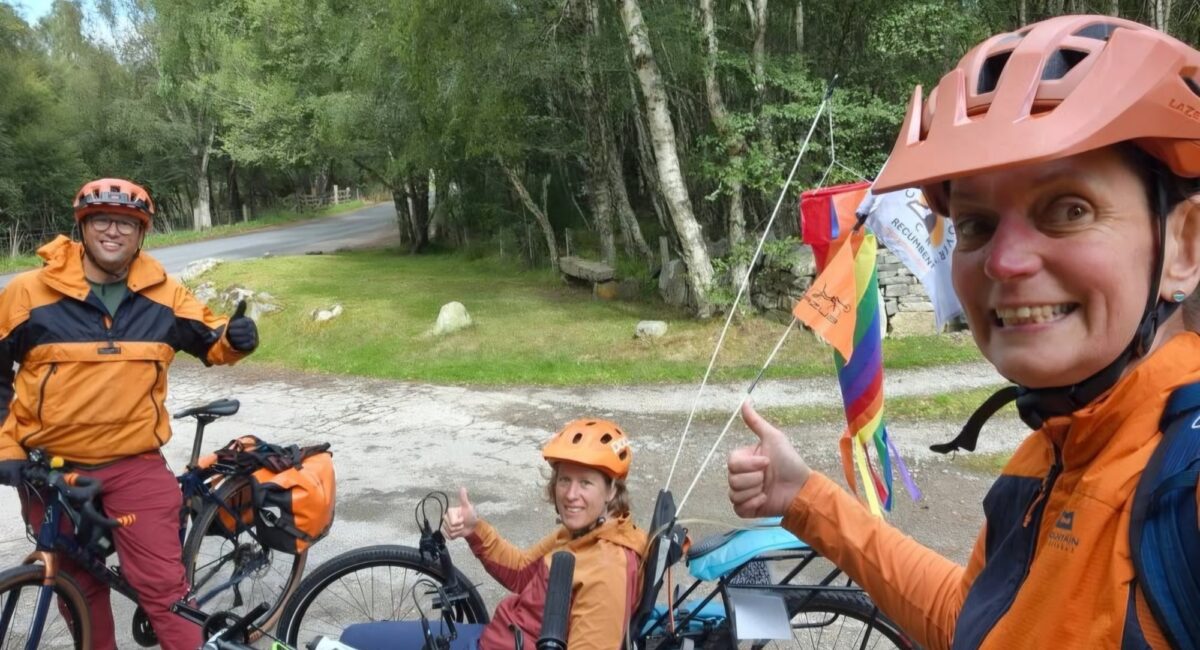
After being told following a serious injury that she would not be riding her bike again for the foreseeable future, Kirsty Spriggs has completed a seven-day, self-supported cycling tour around the Cairngorms mountain range in the Scottish Highlands.
Riding her off-road recumbent trike, Kirsty covered almost 215 miles across seven days, testing both her physical and mental resilience while continuing her recovery journey.
The challenge, known as The Comeback Cycle, marked an important milestone for Kirsty, who was forced to step away from both mountain biking and her role as an RAF Burns and Plastics nurse following a Grade 5 ACJ injury in 2024.
While completing the challenge, Kirsty quickly discovered that some elements of the route would need adapting.
“After completing day one, it became clear that I needed to reassess some of the route,” Kirsty said.
“The trike was fully loaded with everything I needed for seven days, and I found that narrow single-track sections combined with gradients of more than eight per cent were particularly difficult. There was a point where I felt that continuing would potentially put me in a difficult situation, so the decision was made to turn around rather than push on and get into trouble.”
Although she completed the planned mileage on the opening day, Kirsty finished short of her intended destination and spent the evening reviewing the route. What followed was a week of adapting plans, adjusting expectations and learning more about both herself and her trike.
“Initially I was very focused on completing the route exactly as planned, but I reminded myself that the purpose of the trip was to challenge myself, enjoy being outside and have an adventure,” she said.
As well as completing the challenge, Kirsty used the week to better understand what was possible with her recumbent trike across different terrain and conditions.
The biggest challenge, however, was not physical - "the mental aspect doesn’t simply finish once you become physically capable of doing things again. It is still a continual work in progress,” she said.
“There are still times when I compare what I can do now with what I could do before my injury. I still have to remind myself that I am not the same person physically as I was before the injury, and that is something I am still learning to accept.”
The challenge provided another opportunity for Kirsty to work through those realities, learning that when sections of the route proved unsuitable or plans needed to change, adapting and finding another way forward was simply part of the experience rather than a setback.
Support from friends throughout the week also played an important role.
“There was a lot of encouragement and a lot of laughter,” Kirsty said. “It made the experience much more enjoyable and meant I never felt like I was facing the challenges on my own.”
The ride also reinforced the value of the communities that have supported her recovery.
“Through the opportunities I have had with the Invictus Games Foundation and Climb2Recovery, I have met people who understand the journey of being wounded, injured or sick,” she said.
“There is no judgement about what you can or can’t do. People accept you for who you are and encourage you to see what might be possible.”
For Kirsty, completing The Comeback Cycle was never about proving she could do what she did before her injury. Instead, it was about discovering what is possible now as part of her recovery journey.
“My recovery is still ongoing,” she said. “I am learning that I need to accept that the old me is gone and that I need to learn who the new me is. That doesn’t have to be a negative thing. There are still adventures ahead, they might just look different to the adventures I would have had before my injury.”
“The Comeback Cycle showed me that changing the plan isn’t giving up. Sometimes you just need to find a different route. And sometimes that different route includes a café, a lot of cake and some incredible scenery.”